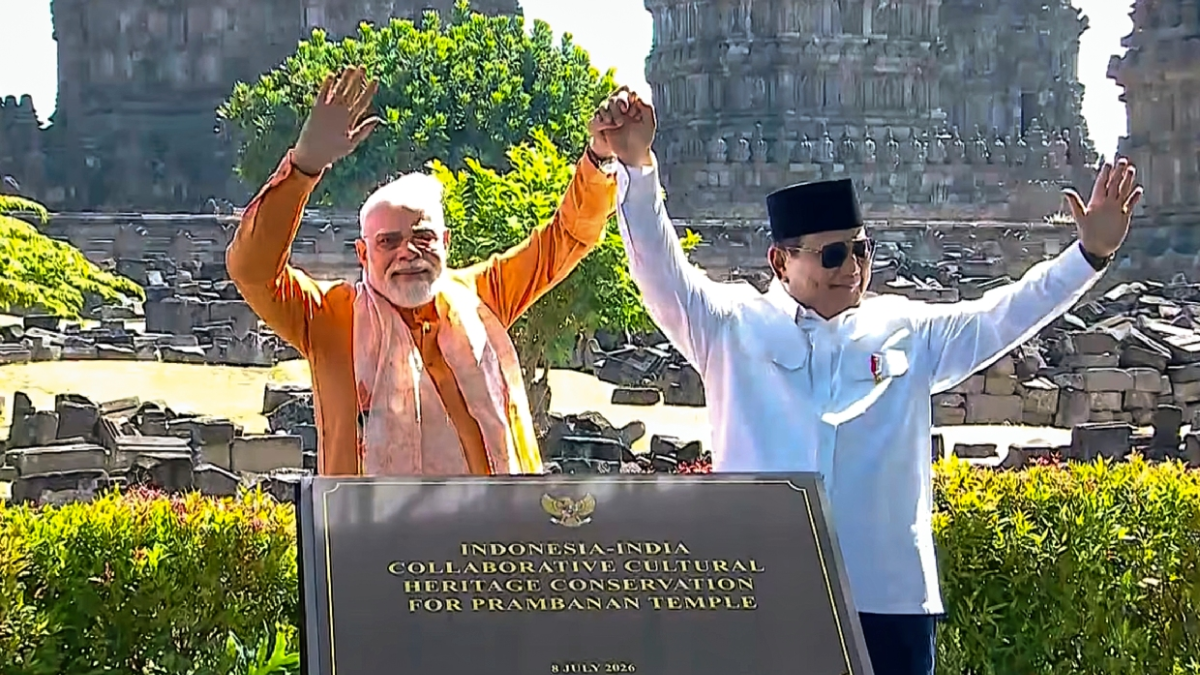
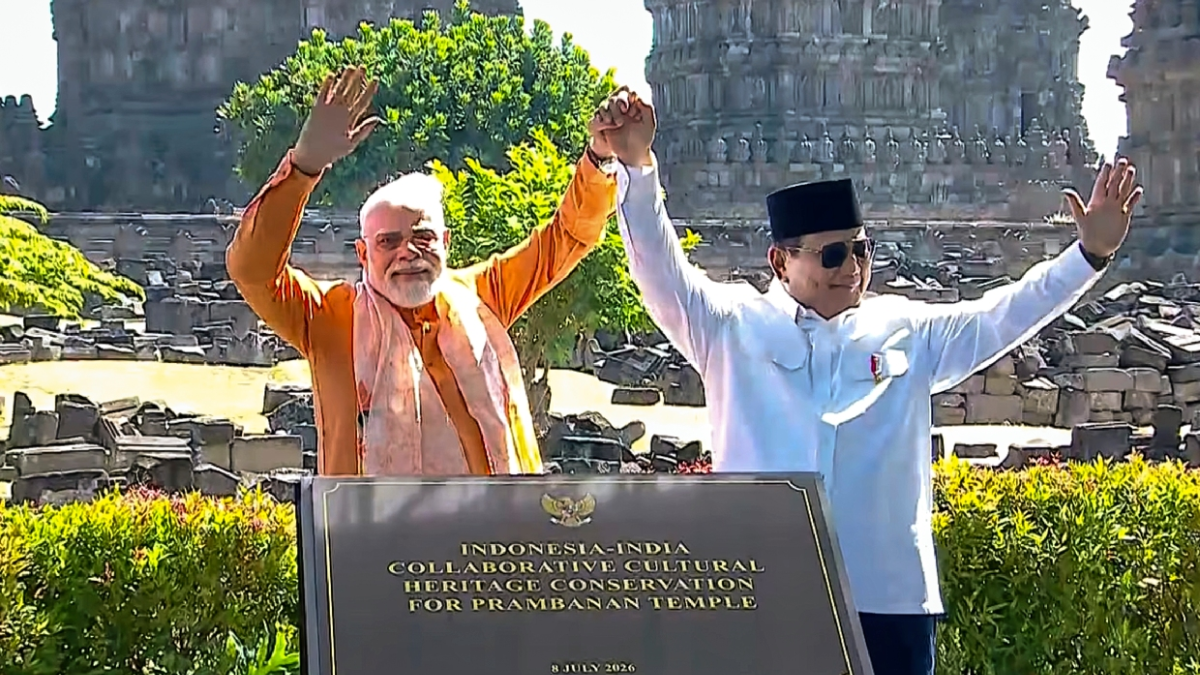


Prime Minister Narendra Modi on Wednesday visited Indonesia's historic Prambanan Temple complex with President Prabowo Subianto, offering prayers at the nearly 1,000-year-old Hindu monument dedicated to the Trimurti — Lord Shiva, Lord Vishnu and Lord Brahma.
Speaking during the visit, PM Modi reflected on his longstanding spiritual connection with Lord Shiva and described it as a matter of great fortune.
"It is my good fortune that I always get an opportunity to connect to Lord Shiv. I was born in Vadnagar where Hatkeshwar Mahadev is located. Somnath Jyotirlinga is the first jyotirlinga, it is located in Gujaray. I have the direct responsibilty of its development. My political constituency of Kashi (Varanasi) has Kashi Vishwanath Mahadev which has continued to bless me. Be it the redevelopment of Kedarnath or that of Ujjain Mahakal, or my visit here, I received the opportunity to start the renovation here. I consider this great fortune," PM Modi said during the visit.
Earlier, as he and President Prabowo travelled by helicopter from Yogyakarta to the UNESCO World Heritage Site, the Prime Minister shared an aerial video of the temple complex on X with the caption: "The majestic Prambanan Temple!"
The visit followed an agreement reached a day earlier between India and Indonesia to jointly undertake the conservation and restoration of the Prambanan Temple complex, further advancing cultural cooperation under India's Act East policy.
During bilateral discussions on Tuesday, PM Modi and President Prabowo exchanged a Letter of Intent for the preservation initiative and reaffirmed their commitment to deepening the India-Indonesia Comprehensive Strategic Partnership aimed at promoting a peaceful, stable and prosperous Indo-Pacific.
Situated on Indonesia's Java island, Prambanan is the country's largest Hindu temple complex and the second largest in Southeast Asia after Cambodia's Angkor Wat. Covering nearly 40 hectares, the site originally comprised about 240 temples and continues to stand as one of Indonesia's most significant cultural landmarks, reflecting centuries-old civilisational ties between the Indian subcontinent and Southeast Asia.
The complex was built in the 9th century under the Hindu Mataram Kingdom and is believed to have been commissioned by King Rakai Pikatan before being completed during the reign of his successor, Lokapala. At its heart are three towering temples dedicated to Lord Shiva, Lord Vishnu and Lord Brahma, with the 47-metre Shiva Temple serving as the tallest and most prominent structure.
Its walls feature elaborate carvings depicting episodes from the Ramayana and other Hindu epics, illustrating the rich cultural and religious exchanges that spread across Southeast Asia through ancient maritime trade routes.
Prambanan was abandoned during the 10th century, with historians attributing its decline to political shifts in Java as well as volcanic activity from nearby Mount Merapi. Many of the structures later suffered damage in earthquakes before restoration work commenced under Dutch colonial administration in the 19th century. Extensive archaeological reconstruction carried out between 1913 and 1953 restored the principal temples.
Designated a UNESCO World Heritage Site in 1991, Prambanan has since become one of Indonesia's premier cultural destinations. The new India-backed restoration initiative is expected to reinforce the enduring civilisational relationship between New Delhi and Jakarta while contributing to the preservation of one of Asia's most important Hindu monuments.
Also Read | Trump Renews Greenland Push, Says NATO Allies 'Let Us Down' as Ankara Summit Opens
Also Read | 'Bond Rooted In Ramayana, Mahabharat': PM Modi Underscores India-Indonesia Cultural Ties